Insights
Green check mark burst shape
Premium

Nervous, Ready, and Stepping Out Anyway

Training at HEROIC prepared me to share my Grief Intelligence™ framework on the TEDx stage.

7
minute read
Published on
July 27, 2026
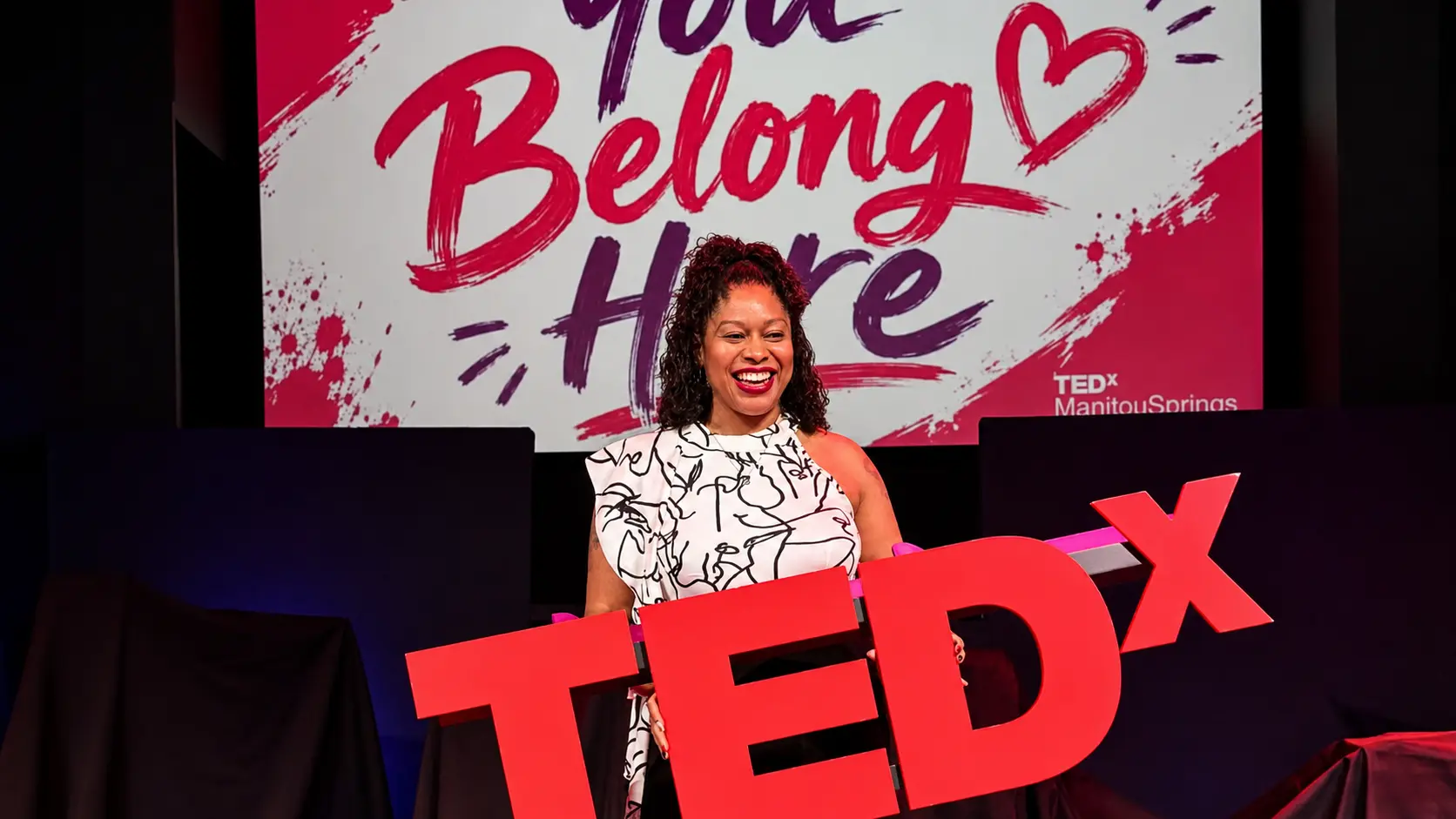
Delivering my talk onstage at TEDx Manitou Springs was a huge milestone in my speaking journey.

This Alumni-written article is part of HEROIC’s Industry Insiders series: a collection dedicated to highlighting the current and authentic experiences of leaders sharing their voices and messages in diverse fields. 

I was nervous, but I knew I was going to give the talk. That was never the question.

The question was whether I could show up fully for it. Whether I could say my daughter’s name out loud, on a stage, in front of strangers, and stay present with the audience. Whether I could be a grief therapist and a grieving mother at the same time, in the same room, authentically.

That is what was sitting with me backstage at TEDx Manitou Springs in Colorado.

The Talk and What It Asked of Me

My talk was on Grief Intelligence™, a framework based on my doctoral research and my own experiences with grief. My Core Message is that grief is not something you push through or get over. It is something you learn to work with; it carries information. It can be a source of clarity and strength if you stop fighting it and let it teach you.

I know this because I have lived it. In 2014, I lost my daughter Jordyn Da’Yana to an incurable congenital heart disease. She was almost two years old when she died.  

That loss changed my life forever; it changed the way I do everything. It is why I founded The Jordyn Effect, Inc. It’s why I wrote the book Holding Space: My Story of Grief, Remembering, and Thriving After Traumatic Loss. It’s why I built the framework. Her name is woven into my work every single day.

Expressing all of that on a TEDx stage, clearly and honestly, to people who did not know me yet, was the real challenge. 

I knew my message needed to be shared—grief is something we all deal with, yet struggle to express and overcome. But I was worried it was too heavy of a topic, that it would be misunderstood. 

That’s why I knew I needed to prepare to step onstage with authentic vulnerability and the power to deliver my message in a way that reached the hearts and minds of the people in front of me. 

What the Preparation Actually Did

I practiced my talk at Toastmasters International, a local space to practice public speaking and get feedback. But working with HEROIC changed how I understood my job as a speaker. I went in thinking the work was about organizing my content well. After all, I had the research, a clear message, and a clinical argument. That part felt solid.

What I had not done was rehearse the emotional weight of the talk. The parts where I talk about Jordyn. The parts where grief stops being a framework and becomes a real human experience—happening in real time, on a stage, in front of an entire audience.

The feedback I got from the HEROIC Performance Faculty was direct: I was moving through those moments too fast. I had to learn to take a beat. 

I realized that I was a clinician doing what clinicians do: staying composed, keeping it together, getting to the next point. And that was exactly the wrong instinct for this talk.

I had to learn to slow down inside the hard moments instead of stepping around them. To rehearse the pauses with the same intention I gave the words. To trust that the audience could sit in the weight of something real. 

That reframe was everything.

Full Transcript

Read Full Transcript
X Mark icon
Don't
Check mark icon
Do
Black right arrow icon
Finally, after a month of intense rehearsal, I reached the point where I felt it—the speech was a part of me.

Know It So Well You Forget It 

During GRAD | Stage Performance Mastery, the HEROIC Faculty always reminded us about the importance of rehearsal. Preparation in public speaking is paramount. They shared that you should know your talk so well that it becomes a part of you. Then, you can internalize it so profoundly that you can forget it, and then have it come back to you in the moment, onstage. That landed deeply with me. 

I had rehearsed my talk a lot. More than I thought I needed to. And when I walked out on that TEDx stage in Manitou Springs, the nerves hit, but after a deep breath and a pause, the talk came back to me. 

I had internalized it. It lived in my body, not just my head. For me, that was a completely different experience than other times when I spoke in front of a group and simply tried to remember what came next.

Stepping Onto the TEDx Stage 

I was nervous. And I was ready. Both things were true at the same time.

I walked confidently onto the stage, planted my feet on that famous red circle, and took a deep breath. As I looked out at an audience filled with dozens of people ready to hear my message, I felt nervous, prepared, and proud—all at the same time. I had worked so hard to get to this moment, and I knew I had earned it. 

I began my talk just like I had rehearsed: “Grief is something we all have in common. Yet no one taught us how to process it well.” 

I said Jordyn’s name. I slowed down. I let there be silence.

Something happened in the room when I stopped trying to manage how people received the talk and just let myself be in it. That is what solid preparation gives you. Not control—room. Room to actually be present with the people in front of you instead of just getting through your material.

After over a month of rehearsal, I stopped performing and started communicating. Those are two very different things, and you can feel the difference when it happens.

It’s more than just memorizing your speech; it’s knowing it. It’s more than just saying the words; it’s expressing them with emotion. That shift was palpable on the TEDx stage. As I looked out into the audience, I saw their eyes focused on me. They nodded, they smiled, some even wiped tears from their eyes. 

What I Want You to Take From This

If you are building a talk from lived experience, from something that cost you something, this is what I know now, and what I’d like to share with you:

Being real beats being polished. Every time. I almost sanded down the most personal parts of my talk to sound more professional, more universal, more clinical. That would have been a mistake. Specificity is what connects. The audience is not looking for a flawless presentation. They are looking for something true and meaningful.

Rehearse the hard parts, not around them. Find the moments in your talk where you want to speed up or skip ahead. Those are the moments your audience most needs you to stay present. Practice being in them, not rushing through them.

Know it well enough to let it go. Do the repetitions. Internalize the talk until it lives in your body. Then trust that when you need it, it will be there. That kind of preparation is what frees you to actually connect with the people in front of you.

Do the open rehearsal. I had the opportunity to rehearse with the other TEDx speakers onstage in the actual place where I would give the talk, and that was so helpful. There is something about performing in front of a real audience, before the real moment, that solo rehearsal cannot replicate. Build it into your process.

Your story is not a liability; it’s what makes your message matter. Do not apologize for it. Do not shrink it to make other people comfortable. Bring it fully, prepare it well, and trust that the right audience will receive it.

The Work Continues

Delivering a TEDx talk was a huge accomplishment for me. But it is also just a step forward towards a bigger goal and a deeper purpose. The message I am sharing is one that will help people not just survive grief, but heal through it.


My goal is to eventually publish a book on Grief Intelligence™ and continue to help others understand the grieving process in a healthy, rather than toxic, way. 

Grief Intelligence™ is not something I developed from a distance. I built it because I had to. Because Jordyn’s death deeply changed me, I chose to work with it instead of against it.

Speaking about deeply personal topics, from a place of grief, pain, and reflection, asks the same thing. Throughout the process, you work with the fear, the weight, the vulnerability. It doesn’t go away. But it can give your work power, purpose, and even freedom

You do the preparation. You trust what you built. Then you walk out and let yourself be fully in the room.

The audience will meet you there.

X Mark icon
Don't
Check mark icon
Do
X Mark icon
Don't
Check mark icon
Do

No Name

First Name
Last Name
Email address
Who referred you?
First & Last Name
Checkmark icon
Thank you! Your submission has been received!
Oops! Something went wrong while submitting the form.
X Mark icon
Don't
Check mark icon
Do
X Mark icon
Don't
Check mark icon
Do
X Mark icon
Don't
Check mark icon
Do

|

Speak, perform, and communicate with confidence.

GRAD

|

Stage Performance Mastery

Inspire your audience to feel, think, and act differently by delivering a transformational message that touches their hearts and minds.
Learn more

First Name
First Name
Last Name
Last Name
Email address
Email address
Who referred you?
First & Last Name
Checkmark icon
Thank you! Your submission has been received!
Oops! Something went wrong while submitting the form.

Know It So Well You Forget It 

During GRAD | Stage Performance Mastery, the HEROIC Faculty always reminded us about the importance of rehearsal. Preparation in public speaking is paramount. They shared that you should know your talk so well that it becomes a part of you. Then, you can internalize it so profoundly that you can forget it, and then have it come back to you in the moment, onstage. That landed deeply with me. 

I had rehearsed my talk a lot. More than I thought I needed to. And when I walked out on that TEDx stage in Manitou Springs, the nerves hit, but after a deep breath and a pause, the talk came back to me. 

I had internalized it. It lived in my body, not just my head. For me, that was a completely different experience than other times when I spoke in front of a group and simply tried to remember what came next.

Stepping Onto the TEDx Stage 

I was nervous. And I was ready. Both things were true at the same time.

I walked confidently onto the stage, planted my feet on that famous red circle, and took a deep breath. As I looked out at an audience filled with dozens of people ready to hear my message, I felt nervous, prepared, and proud—all at the same time. I had worked so hard to get to this moment, and I knew I had earned it. 

I began my talk just like I had rehearsed: “Grief is something we all have in common. Yet no one taught us how to process it well.” 

I said Jordyn’s name. I slowed down. I let there be silence.

Something happened in the room when I stopped trying to manage how people received the talk and just let myself be in it. That is what solid preparation gives you. Not control—room. Room to actually be present with the people in front of you instead of just getting through your material.

After over a month of rehearsal, I stopped performing and started communicating. Those are two very different things, and you can feel the difference when it happens.

It’s more than just memorizing your speech; it’s knowing it. It’s more than just saying the words; it’s expressing them with emotion. That shift was palpable on the TEDx stage. As I looked out into the audience, I saw their eyes focused on me. They nodded, they smiled, some even wiped tears from their eyes. 

What I Want You to Take From This

If you are building a talk from lived experience, from something that cost you something, this is what I know now, and what I’d like to share with you:

Being real beats being polished. Every time. I almost sanded down the most personal parts of my talk to sound more professional, more universal, more clinical. That would have been a mistake. Specificity is what connects. The audience is not looking for a flawless presentation. They are looking for something true and meaningful.

Rehearse the hard parts, not around them. Find the moments in your talk where you want to speed up or skip ahead. Those are the moments your audience most needs you to stay present. Practice being in them, not rushing through them.

Know it well enough to let it go. Do the repetitions. Internalize the talk until it lives in your body. Then trust that when you need it, it will be there. That kind of preparation is what frees you to actually connect with the people in front of you.

Do the open rehearsal. I had the opportunity to rehearse with the other TEDx speakers onstage in the actual place where I would give the talk, and that was so helpful. There is something about performing in front of a real audience, before the real moment, that solo rehearsal cannot replicate. Build it into your process.

Your story is not a liability; it’s what makes your message matter. Do not apologize for it. Do not shrink it to make other people comfortable. Bring it fully, prepare it well, and trust that the right audience will receive it.

The Work Continues

Delivering a TEDx talk was a huge accomplishment for me. But it is also just a step forward towards a bigger goal and a deeper purpose. The message I am sharing is one that will help people not just survive grief, but heal through it.


My goal is to eventually publish a book on Grief Intelligence™ and continue to help others understand the grieving process in a healthy, rather than toxic, way. 

Grief Intelligence™ is not something I developed from a distance. I built it because I had to. Because Jordyn’s death deeply changed me, I chose to work with it instead of against it.

Speaking about deeply personal topics, from a place of grief, pain, and reflection, asks the same thing. Throughout the process, you work with the fear, the weight, the vulnerability. It doesn’t go away. But it can give your work power, purpose, and even freedom

You do the preparation. You trust what you built. Then you walk out and let yourself be fully in the room.

The audience will meet you there.

X Mark icon
Dont
Check mark icon
Do
Finally, after a month of intense rehearsal, I reached the point where I felt it—the speech was a part of me.
X Mark icon
Don't
Check mark icon
Do
,
X Mark icon
Don't
Check mark icon
Do
X Mark icon
Don't
Check mark icon
Do
Education graduation cap black icon
Learn from

HEROIC

Speakers

Learn how to give speeches that transform how people think and perceive the world. We’ll teach you how to write, perform, and get booked.
Learn more
X Mark icon
Dont
Check mark icon
Do
white space
Loading
Someone is typing...
Person icon
No Name
Set
Moderator
(Edited)
4 years ago
This is the actual comment. It's can be long or short. And must contain only text information.
Person profile icon with blue background
No Name
Set
2 years ago
Moderator
(Edited)
This is the actual comment. It's can be long or short. And must contain only text information.
Load More
Thank you! Your submission has been received!
Oops! Something went wrong while submitting the form.
Load More
white space