Insights
Green check mark burst shape
Premium

Cut It Up: How to Use an Old Surrealist Exercise to Fix Your Writing

A speech-structuring trick to strengthen the clarity, flow, and organization of your work

7
minute read
Published on
June 15, 2026
Use this strategy to refine, trim, and clarify your message so it’s easier for your audience to understand.

Most of the time, if a speech is not working, it’s structural. Just like a house: if the doors don’t close right or the sewer system regurgitates into your basement, it’s almost always a problem caused by structural failure. 

‍

That’s because everything in that house relies on its bones. The shape determines how well it functions as a system.

‍

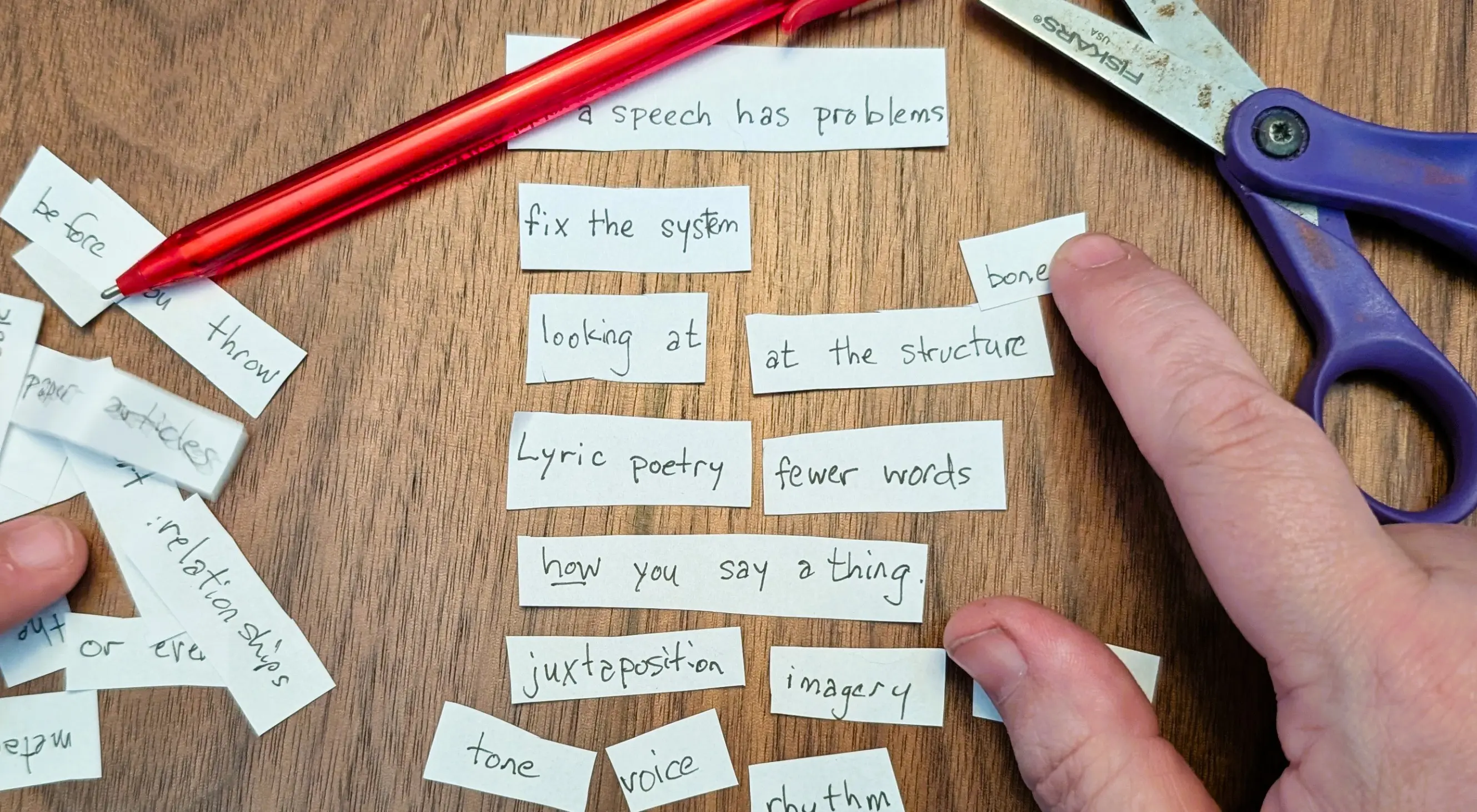
In the same way, if a speech has problems, you usually need to fix the system by looking at its bones. 

‍

Whether it’s an ending that’s not working (or one you just can’t seem to write), unconvincing logic, an “I’m-out-of-ideas” standstill, or a main point you can’t figure out, try taking a look at the structure before you throw in the towel.

‍

Speeches—and Poetry—Depend on Structure

‍

I became a devoted structure fanatic thanks to poetry. Lyric poetry, with fewer words than most written genres (usually, anyway… I’m looking at you Walt Whitman), is so much about how you say a thing. You learn to make use of everything—the juxtaposition of ideas, voice and tone, imagery, rhythm and the music of the language—to get the most impact out of a few words.

‍

That means making use of what meanings get created by the relationships between words, not just each word’s denotation. It’s about verbal economy. It is, in other words, so much about structure.

‍

Of course, all of that goes for other genres, too, but it tends to be less obvious. In a speech, most especially because your reader is usually a listener, what you say is linear.

‍

In other words, a listener experiences what you’ve written in a very time-bound way. She can’t reread or re-experience what’s been said or skip ahead; she has no choice but to plod (or hurry) along the path you guide her down. 

‍

In a speech, you only get one chance with each sentence so, just like with lyric poetry (which was initially also meant to be heard, not read), economy and clarity are key. 

‍

So we might say that a speech is like poetry, in that both are traditionally aural forms and rely heavily on structure to make their meaning.

Full Transcript

Read Full Transcript
X Mark icon
Don't
Check mark icon
Do
Black right arrow icon

Take a Look at Your Speech’s Bones 

‍

As a kid, I had a book about the human body that explained its different systems. In the section on the skeleton, there was an illustration of a person who was a puddle oozing down a set of stairs to show what you would be like without bones. 

‍

Even now, five decades later, the memory of that picture gives me that uneasy shiver of abjection. Without structure, without bones, things become a puddle. One eye is next to the spleen, the other is inside the heart. The veins are a limp pile of spaghetti. No blood flows, nothing works as it should. You can’t make sense of this body. (Goodness knows where the toenails are.)

‍

All of this is to say that if your structure isn’t right, nothing else can be either. What you’ve got is an undistinguished puddle of heart and blood and organs.

‍

Think about the metaphors here (they are binding this hop-skippy little essay together): a speech is like a house, which is also like a body (ever heard of femme-maison? Or the “body” of an essay?). The key is that these are systems, in which each part relies on the others.

‍

In fact, to say something—like a speech—is organized is to compare it to a living body. A body is, by definition, a system. It’s a collection of organs, each with its own function, working in harmony with the other organs to support that body. (See what I did there? A musical composition—with its melody and harmonies—forms a system, too.) As that guy from The A-Team used to say, “I love it when a plan comes together.”

X Mark icon
Don't
underestimate the impact your speech’s organization has on its effectiveness.
Check mark icon
Do
evaluate your speech’s structure to craft a more easily understood and readily accepted iteration of your message.

Cut It Up: An Exercise to Fix Your Writing

‍

With all this in mind, I’d like to suggest my favorite exercise to help you get your house in order. Or get that body into shape. The body of text, I mean.

‍

I often recommend this experiment to anyone struggling with writing difficulty of most any sort:

‍

Need more content, or more examples? Try this. 

‍

Need a better ending? Try this. 

‍

Lacking organization? You got it: try this. 

‍

“This” is an exercise based on the Surrealist poets’ practice of chopping up and rearranging the language of a poem to find new and interesting meanings and music in a new juxtaposition of words. 

‍

It’s a form of defamiliarization—that process of making the familiar strange, so that it cannot be taken for granted, cannot be predicted, must be noticed. (The Surrealists were probably pretty fun people.)

‍

But you are a serious person working on a serious speech, so I’ve reworked this exercise over the years to lend itself to more prosaic—and readily understood—forms like speeches and essays.

‍

You’ll need: 

‍

  • A printed, single-sided copy of your speech 
  • A pair of scissors
  • Clear tape 
  • A pen or pencil 
  • Blank paper
  • Room to spread out

‍

Preserve your original draft electronically (or physically)—this is an experiment, and you want to be free to destroy the copy without worry.

‍

You’ll be dealing with lots of little slips of paper, so close the windows, shut off the fan. You don’t want any air movement to send your hard work fluttering away. (Trust me: This is experience talking.)

‍

Now you’re ready! Here’s how it works: 

‍

  1. Begin by breaking the speech into small “chunks of sense.” Keep these small—a phrase, a word, at most a sentence or two that conveys a discrete idea.
  2. Now get out those scissors and cut it up! Cut the chunks out so you have a bunch of slips of paper, each with a “chunk of sense” on it. You may also have some discarded flotsam—words that don’t make it into the “chunks of sense.” You can discard those.
  3. In the margin of each chunk, write a label: “Main Claim,” or “Supports X,” or “Example of X” or the like.
  4. Now you have yourself an old-fashioned jigsaw puzzle. Rearrange your chunks in a way that makes sense and guides you from introducing the idea through to the wrapping up. Don’t worry about what the original organization was because your goal is to NOT recreate it. Be open to new ideas and new meanings.
  5. You might not use all the chunks—some can go into an “idea folder” to use later in another project.
  6. You might also discover holes in your puzzle, places where you need some connective tissue to get you from idea A to idea C. Write new chunks to add prose later (add a slip that’s labeled “Example,” for instance, or “Transition”).
  7. Play around. And when you’ve found a structure you like, tape it down onto the blank paper. (Or photograph it with your phone. Or laminate it.)

‍

Now you’ve got the bones, an outline. All you have to do is add the meat on there. (And that, as they say, is how the sausage is made.) I’m willing to bet you’ll find the writing—putting meat around the bones—is much easier now.

X Mark icon
Don't
see this exercise as a one-time thing.
Check mark icon
Do
this exercise at any stage of the writing process and return to it as many times as you like.

No Name

First Name
Last Name
Email address
Who referred you?
First & Last Name
Checkmark icon
Thank you! Your submission has been received!
Oops! Something went wrong while submitting the form.

The Key Is Re-Seeing Your Speech Script

‍

Rethinking your structure should be a part of all stages of writing. I like to think of composition (writing the words) and revision (literally re-seeing what you’ve written) as two modes that, together, make up what we call writing. 

‍

All writing swings between composing (putting out) and revising (taking in and processing), a forth-and-back that is a continuous cycle, as natural as sea waves. Often, the processes overlap each other or are hard to tell apart. That’s all OK—learn to respect how you write best.

‍

And if this exercise doesn’t work for you, that’s OK, too. I always suggest people give a technique two or three solid tries (on different projects, at different times, just to be scientific) before giving it up entirely. What works well on one project may not work on the next. What flies for you in January may fall flat in June.

‍

Speaking of June, it’s just warming into summer outside, and I’m going for a walk in the sunshine. (You walk, like you speak in English, in iambic pentameter, by the way. So words come really easily on a walk—it’s good thinking and composing time.) I’m going to take the dogs out for a stroll, then maybe do some gardening. Think some thoughts. Get my house in order.

X Mark icon
Don't
Check mark icon
Do
X Mark icon
Don't
Check mark icon
Do
X Mark icon
Don't
Check mark icon
Do

|

Craft a rehearsal-ready speech script in just three months.

GRAD

|

Speech Writing Mastery

Discover the repeatable process for developing new speeches that "WOW" your audience (and meeting planners) and transform your speaking career.
Learn more

First Name
First Name
Last Name
Last Name
Email address
Email address
Who referred you?
First & Last Name
Checkmark icon
Thank you! Your submission has been received!
Oops! Something went wrong while submitting the form.

Take a Look at Your Speech’s Bones 

‍

As a kid, I had a book about the human body that explained its different systems. In the section on the skeleton, there was an illustration of a person who was a puddle oozing down a set of stairs to show what you would be like without bones. 

‍

Even now, five decades later, the memory of that picture gives me that uneasy shiver of abjection. Without structure, without bones, things become a puddle. One eye is next to the spleen, the other is inside the heart. The veins are a limp pile of spaghetti. No blood flows, nothing works as it should. You can’t make sense of this body. (Goodness knows where the toenails are.)

‍

All of this is to say that if your structure isn’t right, nothing else can be either. What you’ve got is an undistinguished puddle of heart and blood and organs.

‍

Think about the metaphors here (they are binding this hop-skippy little essay together): a speech is like a house, which is also like a body (ever heard of femme-maison? Or the “body” of an essay?). The key is that these are systems, in which each part relies on the others.

‍

In fact, to say something—like a speech—is organized is to compare it to a living body. A body is, by definition, a system. It’s a collection of organs, each with its own function, working in harmony with the other organs to support that body. (See what I did there? A musical composition—with its melody and harmonies—forms a system, too.) As that guy from The A-Team used to say, “I love it when a plan comes together.”

X Mark icon
Dont
underestimate the impact your speech’s organization has on its effectiveness.
Check mark icon
Do
evaluate your speech’s structure to craft a more easily understood and readily accepted iteration of your message.

Cut It Up: An Exercise to Fix Your Writing

‍

With all this in mind, I’d like to suggest my favorite exercise to help you get your house in order. Or get that body into shape. The body of text, I mean.

‍

I often recommend this experiment to anyone struggling with writing difficulty of most any sort:

‍

Need more content, or more examples? Try this. 

‍

Need a better ending? Try this. 

‍

Lacking organization? You got it: try this. 

‍

“This” is an exercise based on the Surrealist poets’ practice of chopping up and rearranging the language of a poem to find new and interesting meanings and music in a new juxtaposition of words. 

‍

It’s a form of defamiliarization—that process of making the familiar strange, so that it cannot be taken for granted, cannot be predicted, must be noticed. (The Surrealists were probably pretty fun people.)

‍

But you are a serious person working on a serious speech, so I’ve reworked this exercise over the years to lend itself to more prosaic—and readily understood—forms like speeches and essays.

‍

You’ll need: 

‍

  • A printed, single-sided copy of your speech 
  • A pair of scissors
  • Clear tape 
  • A pen or pencil 
  • Blank paper
  • Room to spread out

‍

Preserve your original draft electronically (or physically)—this is an experiment, and you want to be free to destroy the copy without worry.

‍

You’ll be dealing with lots of little slips of paper, so close the windows, shut off the fan. You don’t want any air movement to send your hard work fluttering away. (Trust me: This is experience talking.)

‍

Now you’re ready! Here’s how it works: 

‍

  1. Begin by breaking the speech into small “chunks of sense.” Keep these small—a phrase, a word, at most a sentence or two that conveys a discrete idea.
  2. Now get out those scissors and cut it up! Cut the chunks out so you have a bunch of slips of paper, each with a “chunk of sense” on it. You may also have some discarded flotsam—words that don’t make it into the “chunks of sense.” You can discard those.
  3. In the margin of each chunk, write a label: “Main Claim,” or “Supports X,” or “Example of X” or the like.
  4. Now you have yourself an old-fashioned jigsaw puzzle. Rearrange your chunks in a way that makes sense and guides you from introducing the idea through to the wrapping up. Don’t worry about what the original organization was because your goal is to NOT recreate it. Be open to new ideas and new meanings.
  5. You might not use all the chunks—some can go into an “idea folder” to use later in another project.
  6. You might also discover holes in your puzzle, places where you need some connective tissue to get you from idea A to idea C. Write new chunks to add prose later (add a slip that’s labeled “Example,” for instance, or “Transition”).
  7. Play around. And when you’ve found a structure you like, tape it down onto the blank paper. (Or photograph it with your phone. Or laminate it.)

‍

Now you’ve got the bones, an outline. All you have to do is add the meat on there. (And that, as they say, is how the sausage is made.) I’m willing to bet you’ll find the writing—putting meat around the bones—is much easier now.

X Mark icon
Don't
see this exercise as a one-time thing.
Check mark icon
Do
this exercise at any stage of the writing process and return to it as many times as you like.
,

The Key Is Re-Seeing Your Speech Script

‍

Rethinking your structure should be a part of all stages of writing. I like to think of composition (writing the words) and revision (literally re-seeing what you’ve written) as two modes that, together, make up what we call writing. 

‍

All writing swings between composing (putting out) and revising (taking in and processing), a forth-and-back that is a continuous cycle, as natural as sea waves. Often, the processes overlap each other or are hard to tell apart. That’s all OK—learn to respect how you write best.

‍

And if this exercise doesn’t work for you, that’s OK, too. I always suggest people give a technique two or three solid tries (on different projects, at different times, just to be scientific) before giving it up entirely. What works well on one project may not work on the next. What flies for you in January may fall flat in June.

‍

Speaking of June, it’s just warming into summer outside, and I’m going for a walk in the sunshine. (You walk, like you speak in English, in iambic pentameter, by the way. So words come really easily on a walk—it’s good thinking and composing time.) I’m going to take the dogs out for a stroll, then maybe do some gardening. Think some thoughts. Get my house in order.

X Mark icon
Don't
Check mark icon
Do
X Mark icon
Don't
Check mark icon
Do
Education graduation cap black icon
Learn from
Kristin

HEROIC

Speakers

Learn how to give speeches that transform how people think and perceive the world. We’ll teach you how to write, perform, and get booked.
Learn more
X Mark icon
Dont
Check mark icon
Do
white space
Loading
Someone is typing...
Person icon
No Name
Set
Moderator
(Edited)
4 years ago
This is the actual comment. It's can be long or short. And must contain only text information.
Person profile icon with blue background
No Name
Set
2 years ago
Moderator
(Edited)
This is the actual comment. It's can be long or short. And must contain only text information.
Load More
Thank you! Your submission has been received!
Oops! Something went wrong while submitting the form.
Load More
white space